Showing posts with label brain. Show all posts

Monday, July 21, 2008

What other types of information get in through our eyes?

Enlace a entrada en español.

Besides the four important routes that the visual information makes to process it (and that I already showed you in the previous post), there are certain stimuli that get in through the eyes and also that go to other nervous system pathways to cause the right answers.

EXAMPLE 1:
When we get across a tunnel, we turn on the car headlights on, but even so, our eyes have to get used to the sudden decrease of the light in order to see clearly again, and drive safely.

In order to achieve this action, this information arrives to the PRETECTUM (a structure in the mesencephalon next to the Superior Colliculus). This structure sends the information about “poor light”, to the EDINGER-WESTPHAL NUCLEUS and from there, finally to the CILIARY GANGLION. This last structure sends a command to the DILATOR MUSCLE of the iris, in order to increase the pupil size (i.e. it dilates), and so, to get more light into the eye. Thus, the rods of the retina are stimulated, and they give us the information that we need in order to keep on driving in those conditions.


When we get out the tunnel, the process is shorter. The information about “much light”, stops in the EDINGER-WESTPHAL NUCLEUS, who sends a command to the SPHINTER MUSCLE of the iris in order for the pupil to decrease its size (i.e. it contracts), less light gets into the eyes and therefore so we are not dazzled at all so we can see clearly quickly.


EJEMPLO 2:
The “STOP” sign one: Everything gets inside through the eyes, but as I explained in the previous post, the Lateral Geniculate Nucleus (LGN), is responsible for filtering this information so that the brain is not saturated with unnecessary information. So, the ATTENTION is involved in this process and that “attentional window” is controlled through another nucleus placed in the Thalamus: PULVINAR.

There are two routes: in one hand, the route that “facilitates the attention” and that leads it to one or another object (the STOP sign, the white line, the car in front of us…) or increase its attention range (we pay attention to everything surrounding us, to what is the car that has priority to get out of the STOP sign cross in the first place,….). And this information passes through the Pulvinar.

In the other hand, the route that “inhibits the attention” (children playing in the car behind, the shopping bag that falls over when we press the brake,…). This route is direct between the Lateral Geniculate Nucleus and the Occipital Lobe.

These routes are MAGNO, that is, unconscious routes. Fortunately we do not have to control consciously everything at the same time and many of previous routes: if we had to, a simple “STOP” sign will be chaotic.


But besides these examples or these nervous structures, there are many others with the same importance, that are also involved in this visual information processing.

For instance, the CEREBELLUM. It is the structure responsible for the coordination, the balance and the movement; therefore, it allows us to do precise movements in order to position the car right before the white line, put our hand on the wheel, put our foot on the brake pedal,…

Another example is the HIPPOCAMPUS. It is a structure located in the medial temporal lobe and is structure responsible for long and short term memory; therefore, it allows us to remember what the traffic sign means, what we have to do before it, what streets we have to take to arrive to our office, what breakfast we had breakfast this morning,…


As you see, when we are driving a car it is not only important the “what” but also the “where”, that is, we not only see the sign and see it clear, but also to need to know and interpret it: recognizing it, identifying it, remembering it, relating to the rest of information that we have, ignoring whatever it does not contribute, knowing how to act before it, knowing what we can or must do, how long and where we can move according to where we are,…

That is, in order to drive a car, to play tennis or just to walk or to move from one place to another, if we only have a picture of the things that we see, our brain can not make those judgements that are so necessary.

RELATED POST
Where does what we see go? - Visual Information Processing (from the eye to the brain)

Monday, July 14, 2008

Where does what we see go? - Visual Information Processing (from the eye to the brain)

Enlace a entrada en español.

I am sure much of you think the image stops in the eye, that is, that this is where the process ends. We see with the eyes, don’t we? But maybe, after you read the previous post, your thoughts are confused.
In the other hand, I am sure some of you know that the brain is involved in this process but you do not know or understand very well how the connection is between eyes and brain.

It is true that this process is complicated ENOUGH, that is why, so it is easier to understand, I will show how what we see is processed from a practical example and with some graphics.


Let’s suppose we are driving on a street and we are arriving to a cross. In the corner we see the “STOP” traffic sign.

I am going to show you how much information is processed just when seeing this simple traffic sign.


- In the first instance, we have the VISUAL PROCESS itself, that is, obtaining the clear image.

If you remember the previous post, the image created in both eye foveas is processed by the cones (A) that are in the central area of the retina. They send the information to the parvo ganglion cells (C) and leave the eye across the optic nerve (11) . These ganglion cells take the information about the color, bright, clarity and contrast of the STOP traffic sign to the LATERAL GENICULATE NUCLEUS. This is a relief and control station in the visual pathway: almost all information -that the parvo ganglion cells receive-arrives here, and this structure filters and leads it towards the respective places in the brain. So, only ten percent of this visual information is sent to the OCCIPITAL LOBE or VISUAL CORTEX, in order to create the image.


This particular process is incredibly much more complex, but by now, this is enough to understand the rest of the visual information processing

______________________________________

The rest of the pathways that take part in this visual information processing, are not called “visual pathways”, because the information does not go to the occipital lobe directly. The following information that is processed, is not purely visual, although the information had been obtained through the eyes.

- Therefore, in the second instance, we have the following PROCESS: EYES -> SUPERIOR COLLICULUS -> PARIETAL LOBE. In this process the information about “Where am I?” is obtained:

This pathway is made up basically of magno ganglion cells (C) that received the information from the rods in both retinas.

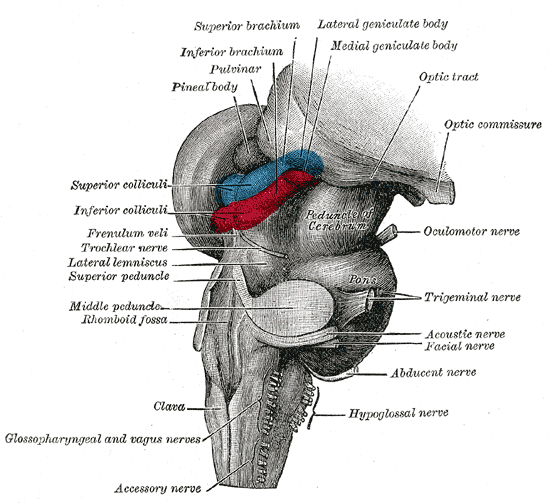
The Superior Colliculus is a paired structure of the nervous system placed in the mesencephalon (2) , right under the thalamus. The Superior Colliculus belongs to the Brainstem, which is the structure that joins the Brain and the Spinal Cord.
It deals to integrate the visual input with the auditory, somaticsensory (about balance and proprioception, among others) and tactile input; and thus we achieve the information about “Where are we?”.
In order to answer this question, the Superior Colliculus makes eyes and head move automatically towards the stimuli in the environment.

In the practical example, the group of all information is processed so that the Posterior Parietal Lobe allows us to calculate our movement, the speed of our car, the strength that we need to do in order to put our foot on the brake pedal, the direction of our car, or the rest of the cars, where our feet are, where our hands are, where we have to stop near the traffic sign… This lobe give us a metal spatial map about ourselves.


Therefore, when we have a car crash with a collision from behind, our head suffers a “lash” front to back, and in this case, the part of the brain is usually is affected is the mesencephalon, so, as well as we suffer strong cervical pains after the accident, it is also frequent to suffer disorientation, poor concentration, panicky feeling in places with crowd or difficulty for going up or down stairs. These are symptoms that seems light and that many people might not attribute to the car crash, but they make their daily life difficult. We can help these people by using Vision Therapy to get back the lost stability back.


- In the third instance, we have the following PROCESS: OCCIPITAL LOBE -> -> POSTERIOR PARIETAL LOBE. In this process the information about “Where is the object?” -the traffic sign-, is obtained:

The information from magno ganglion cells that arrives to the occipital lobe, does not stop here; some of these mango ganglion cells (C) go to Medial Temporal Lobe and, from there, go to the posterior parietal lobe to give us some information about “Where is the stop?”: Where is the line? Where must we stop? Where is the brake pedal to put our foot? Where is the car behind us or in front us?... As I explained above, Parietal Lobe allows us to make special calculations, as in the previous process. This lobe gives us a mental spatial map about our environment.

The information about “Where am I?” and “Where is the object?” allows the parietal lobe to make a motor plan, that is, “how we must do the things”. This lobe allows us to look at the road in the mean time: we look at the mirrors, we turn the wheel if it is necessary, we keep on the security distance regarding the front car, turn on the headlights if we get into a tunnel, we talk to another person in the car, we listen to the radio,...

But if you think about it, this process is carried out unconsciously, that is, all information that comes from the peripheral retina (Magno system) is processed and is carried out automatically. The same thing happens when we are driving on a road and we find an obstacle in our lane; then we look at the rear mirror and if there is not any further risk, we slightly turn the wheel to avoid it.
The responsible lobe for carrying out this action is the parietal one, but we have to do that unconsciously, as a reflex.


When we want to pass another car in the road and we have another one in the opposite direction, this lobe gives us some information about the following: what speed is the other car going at? What speed is the front car going at? What speed is our car going at? What car is moving faster? Do we have enough time to pass without risk?...


- Finally, in the fourth instance, we have the following PROCESS: OCCIPITAL LOBE -> INFERIOR TEMPORAL LOBE. In this process, the information about “What is the object?” -the traffic sign-, is obtained:

Some of the information that arrives to occipital lobe through the parvo ganglion cells (C) from both retinas, do not stop here, they goes to the inferior temporal lobe in order to give us information about what we are seeing: the ”STOP” traffic sign. This information helps us identify what we see: it is a traffic sign, what kind of traffic sign is or what it means; and thus we can know how we have to answer (according to our experience).
This lobe is responsible for the language, that is why, it helps us to give a meaning to the things.


________________________________________


These are the four basic routes, but many others are created in the brain at the same time. I will show some of them in the next post, that it will be posted sooner than usual.

As you see, the brain is so complex and I have just showed you one part. But among many strange names of nervous structures (that I repeat, you do not need to remember), what I want you is to realize that in a few seconds, our brain works 100% and that there are maaaaany activities generated inside; this way, it is able to very effective receive, process and answer from what we see if the visual information processing is correct.

RELATED POST
What other types of information get in through our eyes?

Tuesday, March 04, 2008

What is VISION? Its importance.

Enlace a entrada en español


As many people know, VISION is one of the five traditional senses. Nowadays, some people include in this group the balance and the proprioception too; I will calmly explain these terms later on.


Vision is the most important sense because up to 80 percent of the information that we receive, gets in across the eyes; not only the images but all the feelings that come with them too. That is why, it is very important that the visual system is effective, because it affects the learning and even the behaviour. In the reading case, up to 100 percent of the information that gets in, is purely visual.


People usually technically define VISION as “Action, effect and ability to see”. But personally, this definition does not satisfy me.


Vision does not occur only in the eyes. The eyes are just the most external part of a “complex mechanism”. They are the entrance. They are just responsible for receiving the object’s image; it is a very important function, but we do not see just because of them. Later on this image and all the information about it, follow a process until the brain is reached, and there we process, identify, understand, memorize, remember, learn and answer all the information that we receive. All that is VISION. Thereby, it is not only important that the image gets in but also knowing what to do with it. And that is what separates us from the animals; they receive an image that goes to the primitive brain but they do not learn from, memorize, understand, interpret it... The thinking part is what makes us different. And this is achieved by the NEOCORTEX (the “wrinkled dough of the brain”).


Thereby, in order for vision to be perfect, it is required for the COMPLETE visual path (not only the eyes) to be in perfect condition.

Vision is not efficient if:
- any of the eye’s layers prevent the light from getting in, that is, they lose their transparency;
- the light is not transmitted from neuron to neuron from the first layer of nervous cells which is inside the eye (which is known as the retina, the layer that receives the luminous stimulus), as far as the last neuron of the brain (in many areas of it, not only in the purely visual one);
- or there is some injury in any part of the visual path.

In another post I will explain the steps that occur in the Visual Process and that the vision does not just mean seeing 20/20.


It is crucial to have a good vision for the general development of a person’s life, and it is the most important tool for a child to have success at school. If the vision fails, the child’s school performance or the adult’s work performance fails too. Take one moment to think how many visual activities we do every day: at school or at work: reading, writing, drawing, painting, building, calculating, having contact with other people, fixing some things, cutting hair, putting bricks,… And during the rest of the day: when we take the right bus, drive, walk the street, eat, cook,…
Constantly, we are receiving visual information from which experiences are created. They can be better or worse depending on the quality of the information that we receive.

Nowadays, in Spain, the Optics-Optometrist National Association (Colegio Nacional de Ópticos-Optometristas –CNOO-) and in USA, the College of Optometrists in Vision Development (COVD) estimate that:
- up to 25 percent of the schoolchildren may have visual problems not diagnosed, that can affect their ability to learn (COVD) (CNOO)
- up to 70 percent of schoolchildren who have a learning disability in reading have some sort of visual problem; (COVD)
- and around 30 percent of school failure is related to visual upsets. (CNOO)


One child thinks everybody sees the same way as him; so, if he sees wrong, he will say nothing because he will think that it is usual. Therefore, the parents and teachers are the ones who have to suspect or recognize whether a child has some visual problem. The discovery and early treatment, before or during school-age, can avoid some future academic, emotional and social problems in the child. In future posts I will give a list of some signs and symptoms of visual problems that may indicate the need for a comprehensive vision exam, that I hope it serves you as an orientation.


When we are born, the vision is not a sense totally developed; so, everybody has to “learn to see”, just like we learn to walk. We have to learn to interpret the visual information that we receive. And just as the child’s motor development happens step by step while growing, the same happens with the vision. Both developments happen in parallel. So, if the child skips any motor development phase, it can affect the visual development, thus causing lazy eye, strabismus, or learning disabilities.


“We do not see with the eyes, but through the eyes” (Larry McDonald O.D.)